
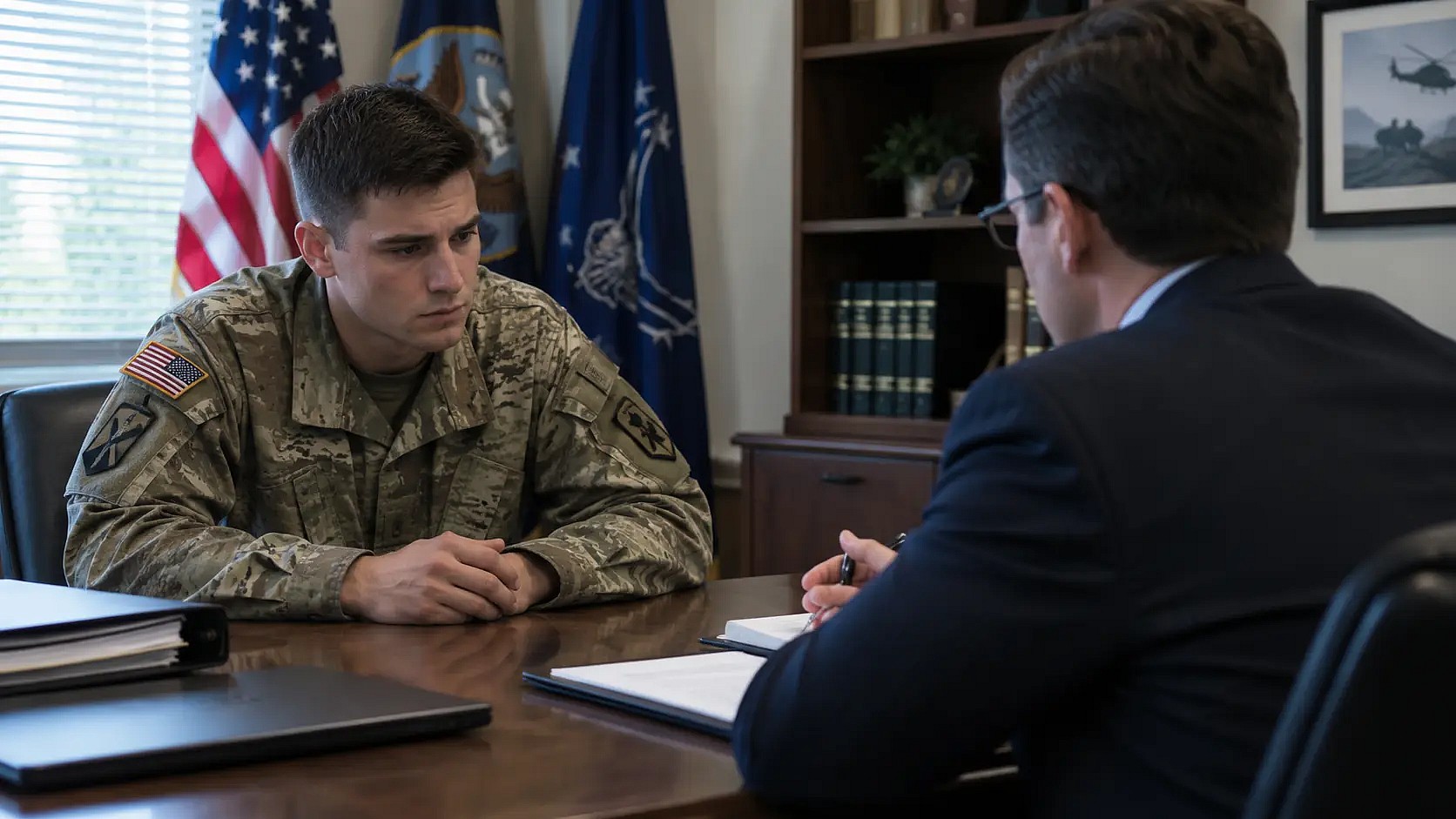
Being accused of a crime in the military can be stressful and confusing. An accusation, however, is not the same thing as guilt. The military justice system includes multiple stages for reviewing allegations, gathering evidence, making charging decisions, and determining potential consequences. The exact timeline and outcome can vary significantly depending on the facts, the branch of service, and the circumstances of the case.
Understanding what may happen after an allegation is made can help service members make informed decisions and avoid mistakes that could affect their future.
Step 1: The Initial Allegation and Command Awareness
A military criminal allegation may begin in several ways. A complaint, incident report, third-party statement, or direct report can bring an issue to the attention of a service member’s command. Once leadership becomes aware of an allegation, commanders may have discretion regarding how the matter should initially be addressed.
Not every allegation immediately becomes a formal criminal investigation. A command may conduct an informal inquiry to determine what happened and whether additional action is appropriate. Other circumstances may warrant a formal investigation by a military law enforcement agency.
If you have been accused of misconduct, consulting a military defense attorney early can help you understand your rights and potential exposure before you make statements or take other actions. More information about defending against these allegations is available through our Court Martial Defense resource.
Step 2: The Criminal Investigation: CID, CNIS, and OSI
When an allegation involves potential criminal misconduct, a military law enforcement agency may become involved. The agency conducting the investigation generally depends on the service branch, the circumstances of the allegation, and the specific section of the UCMJ any potential charges fall under.
The CID investigation process can involve interviews, collection of physical or documentary evidence, review of electronic information, and other investigative activity. Investigators gather facts and develop evidence; they do not determine whether an accused service member is guilty.
The NCIS investigation is associated with the Department of the Navy, including matters involving sailors and Marines. Air Force and Space Force matters may involve the Air Force Office of Special Investigations (OSI).
A CID investigation timeline is not necessarily predictable. Some investigations may move relatively quickly, while complicated cases can take substantially longer because of the number of witnesses, evidence involved, or investigative steps required.
Likewise, the NCIS investigation process can vary depending on the nature and complexity of the allegations. A service member should not assume that the length of an investigation determines whether charges will ultimately be filed.
If investigators contact you, understand your rights before answering substantive questions. Additional information about responding to military investigators is available in our article, What to Do if Questioned by CID, NCIS, or OSI.
Step 3: Your Rights During a Military Investigation
Service members have important rights during military criminal investigations. Article 31 of the Uniform Code of Military Justice provides protections concerning statements made by a person suspected or accused of an offense.
In appropriate circumstances, a service member may have the right to remain silent. There may also be a right to consult with counsel before answering questions. These protections are particularly important because statements made during what may appear to be an informal conversation can potentially become evidence.
If you are the subject of an investigation, you should carefully consider whether answering questions could create additional problems. Attempting to explain everything immediately does not necessarily resolve an allegation and can sometimes create inconsistencies or admissions that investigators may later examine.
A military criminal defense lawyer can explain your rights and evaluate how to respond to investigators, command personnel, or other authorities.
Step 4: Evidence Review and Charging Decisions
An investigation does not automatically lead to criminal charges. After investigators gather evidence, prosecutors and command authorities may review the information and determine what action, if any, is appropriate.
One potential step is the preferral of charges. In general terms, preferral means formally presenting charges against a service member under the UCMJ. This is an important development, but it does not by itself establish guilt.
The evidence may ultimately be considered insufficient for criminal charges. Command authorities may also determine that another form of resolution is more appropriate. Consequently, a CID investigation can end without a court-martial.
Similarly, the existence of an investigation does not mean a service member will necessarily face the military court-martial process. Charging decisions depend on the facts, evidence, applicable law, and circumstances of the individual case.
Step 5: Possible Outcomes After an Accusation
Several outcomes are possible after a military criminal allegation.
No Action or Administrative Resolution
Some allegations do not result in criminal charges or punishment. A matter may be closed without further action, or the command may address the issue administratively.
Nonjudicial Punishment
A commander may consider nonjudicial punishment under Article 15 of the UCMJ when appropriate. Article 15 proceedings provide a mechanism to address alleged misconduct without proceeding to a court-martial.
Learn more about this option through Understanding UCMJ Article 15.
Court-Martial Charges
More serious allegations may result in charges being referred to a court-martial. The court-martial process includes multiple stages, and the specific procedures depend on the type of court-martial and circumstances of the case.
A court-martial can carry significant consequences, making legal advice particularly important when criminal charges are being considered. Potential consequences are discussed in our Court-Martial Consequences article.
Step 6: Administrative Consequences Even Without Criminal Charges
Criminal charges are not the only potential concern following an allegation. A service member may face administrative consequences even when a matter does not proceed to trial.
Depending on the circumstances, an allegation can affect evaluations, assignments, promotions, security-related considerations, or a service member’s standing within the command. The consequences depend heavily on the nature of action taken by military authorities.
This is one reason “What is a CID investigation?” is an important question for anyone contacted by military investigators. Understanding what an investigation means– and what it does not mean– can help prevent unnecessary panic while ensuring that the service member takes the situation seriously.
Step 7: Why Early Legal Advice Matters
The period immediately after an accusation can be critical. Early legal advice is not necessarily about assuming the worst; it is about preventing avoidable mistakes.
A qualified attorney can help a service member understand the allegations, identify potential legal issues, protect applicable rights, and evaluate the possible paths forward. Getting advice before making statements can also help ensure that decisions are made deliberately rather than under pressure.
Understanding the question of “What is a CID investigation?” can also help put the situation into perspective. An investigation is a fact-gathering process, not a determination of guilt.
Likewise, understanding the court-martial process before charges are referred can help a service member recognize what may lie ahead and what decisions may require immediate attention.
Ultimately, every case is different. The NCIS investigation process, command actions, evidence review, and potential disposition can all vary based on the facts and the branch involved.
If you have been accused of a military crime or contacted by military investigators, obtaining legal guidance early can help you protect your rights and make informed decisions. You can contact Conway & Associates through our firm’s Contact page to discuss your circumstances.
Categories
Related Posts
-
Can You Be Court-Martialed After a Civilian Trial? Double Jeopardy in the Military
Jan 22View ArticleWhen service members resolve a criminal matter in civilian court, many believe the legal process has fully concluded. In the military justice system, however, jurisdiction overlaps, sovereign authority differs, and constitutional protections operate under unique rules. One of the most misunderstood protections covers the double jeopardy military members face, particularly when they are forced to...
-
US V. CPL Lindsey Scott
Feb 01View ArticleIn 1983, a woman was attacked near the Quantico Marine Base in Virginia. The victim’s description of her assailant prompted the military officers to convict and court-martial Corporal Lindsey Scott, the only black MP in the Quantico Criminal Investigation Division, despite his pleas of innocence. He was initially convicted and sentenced to 30 years in...
-
Military Speedy Trial Rights
Jan 28View ArticleUnder the US Constitution, an accused enjoys the right to a speedy trial. US v. Danylo, 73 M.J. 183 (C.A.A.F. 2013). A service members 6th Amendment right to a speedy trial triggers upon the preferral of charges or pretrial restraint. That right is also codified in Article 10, UCMJ. Military courts look at 4 issues...